





15ml 30ml 50ml AS Green Airless Cosmetic Bottles
When I talk with Cosmetic Packaging buyers, I find that most of them are not looking for a bottle that simply looks good in a product photo. They want something that can be sampled, tested with the formula, customized, produced in quantity and shipped without creating unnecessary problems.
That is exactly how I look at our 15ml 30ml 50ml AS Green Airless Cosmetic Bottles. The bottle combines an AS material structure, green appearance and airless Pump design in three practical capacity options. It can be considered for skincare, lotion, cream, serum, eye-care and other compatible Cosmetic Products.
At Yuyao Dingyu Plastic Industry Co., Ltd., we manufacture cosmetic packaging in our own factory in Yuyao, Ningbo, Zhejiang Province. We have been working in cosmetic packaging for many years and have built our business around Airless Bottles, lotion bottles, perfume bottles, PET bottles and other beauty packaging.
What I like about this bottle is its balance between appearance and everyday function. The green body gives the package a recognizable visual direction, while the airless pump offers a clean dispensing method. The three available sizes also make it easier for a brand to build a related packaging series instead of using completely different bottle styles for every product.
Of course, I would never tell a customer that one bottle automatically fits every cosmetic formula. Packaging and formula need to work together. That is why we encourage sample evaluation before mass production, especially when the product is a new cream, serum or lotion formulation.

In simple terms, this is a plastic cosmetic bottle with an airless dispensing structure, available in 15ml, 30ml and 50ml sizes, with a green appearance and AS material used as part of the bottle construction.
The word “AS” is important because it identifies the material specified for this product. However, I prefer not to attach a long list of unsupported chemical or performance claims to the material. In real packaging projects, the finished result depends on the actual material grade, bottle structure, pump components, formula and manufacturing process.
The green appearance is mainly a visual feature. It gives brands another option when developing a skincare or beauty product identity. Depending on the customer's requirements, we can also discuss color matching and additional decoration such as silk-screen printing, hot stamping, frosting and other surface finishes.
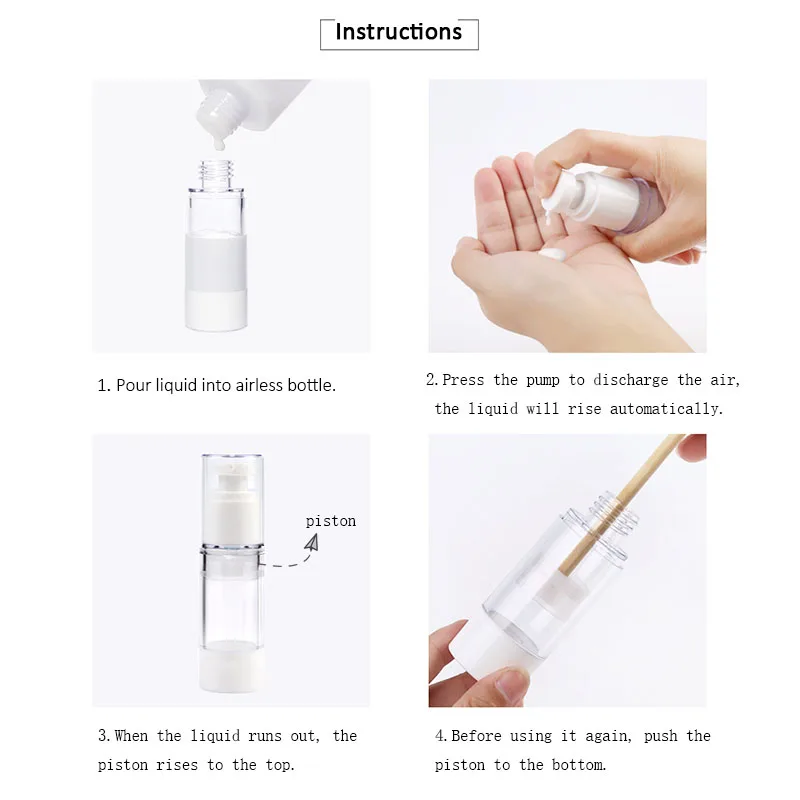
The airless structure is the functional part that attracts many skincare brands. Unlike a basic open cosmetic jar, the user presses the pump to dispense the formula. Depending on the internal design, Airless Packaging uses a mechanical dispensing system that moves the product toward the outlet without relying on the same traditional dip-tube arrangement.
Aptar describes airless packaging as a dispensing system combining a mechanically activated pump with a specially designed container that delivers product without air intake. Its airless portfolio includes different mechanisms and packaging structures, so the exact internal construction can vary from one product to another.
For our bottle, I therefore focus on what the customer can actually evaluate: the appearance, size, pump operation, dispensing behavior, assembly, formula compatibility and finished packaging condition.
The 15ml, 30ml and 50ml options give brands room to build different product formats within a related packaging style.
A 15ml bottle can be considered for smaller Skincare Products such as eye cream or concentrated treatment products. A 30ml bottle is a practical size to consider for serum and facial-care products. A 50ml bottle gives more capacity for daily-use creams, lotions and moisturizers.
These are application suggestions rather than fixed rules. I always recommend choosing the final capacity based on the actual filling volume, product viscosity, target market and consumer usage habits.
| Capacity | Possible Cosmetic Application | Typical Packaging Consideration |
|---|---|---|
| 15ml | Eye cream, treatment cream, concentrated skincare | Compact format for smaller-volume products |
| 30ml | Serum, facial lotion, facial cream | Flexible size for facial-care product lines |
| 50ml | Face cream, moisturizer, lotion | More capacity for daily-use skincare |
Source: Application suggestions are based on the supplied product positioning and common cosmetic packaging applications. For comparison, Aptar lists 15ml, 30ml and 50ml airless formats for skincare and beauty applications in some of its product ranges. This does not mean its specifications apply to our bottle.
I usually explain the airless principle in plain language because a customer does not need to become a pump engineer to choose packaging.
Imagine the cosmetic formula sitting inside the bottle. When the user presses the pump, the internal dispensing system moves the formula toward the outlet. The user receives the product through the pump instead of opening a large container and scooping the product out by hand.
Different Airless Bottles use different internal designs. Some use a piston system. Others use a bag-in-bottle structure or another mechanical arrangement. The purpose is to create controlled dispensing while limiting or avoiding the same type of air intake found in conventional pump systems.
Aptar explains that airless systems can use piston or bag-in-bottle inner structures to push formula upward and improve product evacuation. Its published product ranges also show that airless packaging can be designed for different viscosities and dosage requirements.
But there is one point I always make clear: airless does not mean that every airless bottle has exactly the same performance.
Pump design, actuator, valve structure, piston or inner cartridge, bottle dimensions, formula viscosity and filling method can all affect the final dispensing experience.
That is why I prefer testing the actual finished package instead of making a broad promise based only on the word “airless.”
In a conventional pump bottle, a dip tube normally reaches down into the formula and the pump draws the product upward.
In an airless system, the internal structure is designed differently. Mechanical movement inside the package helps move the formula toward the dispensing opening. The exact movement depends on the specific airless design.
For a brand owner, the important thing is not the engineering diagram. The important questions are much simpler:
Does the pump prime properly?
Does the formula come out smoothly?
Is the dispensing amount consistent?
Does the pump continue working after repeated use?
Does the formula remain compatible with the package?
Does the package remain stable during storage and transportation?
These are the questions we encourage customers to check during sample evaluation.
Airless packaging is often selected when brands want to control air exposure during dispensing. Industry packaging suppliers position airless systems for skincare formulas where protection from external factors can be important. Aptar, for example, describes airless technology as supporting formula protection and controlled dispensing.
However, I would not say that an airless bottle automatically extends shelf life or prevents oxidation. Those results depend on the complete formulation and packaging system, including ingredients, preservatives, filling process, sealing, storage and testing.
That distinction is important when writing technical product information. A packaging supplier should describe what the package is designed to do without turning general airless principles into an unsupported guarantee.
The green color gives this bottle a clear visual identity. Green is commonly used in skincare packaging where brands want a fresh, botanical or clean visual direction, although the final brand meaning is always determined by the complete design.
We can discuss color matching when customers need a specific shade. The actual color should be confirmed through physical samples because screen colors and printed color references can differ from the final molded or decorated package.
The product is specified as an AS Airless Bottle. We use the supplied material requirement as the starting point for manufacturing and customization.
I avoid making blanket claims about AS material performance because cosmetic packaging performance depends on the exact grade, wall structure and formula. If a customer has a special compatibility requirement, we recommend testing the actual formula with the final bottle.
The pump structure provides a convenient dispensing method and is one of the main reasons brands consider airless packaging.
For skincare products, pump dispensing can also provide a cleaner user experience compared with opening a jar and repeatedly touching the formula.
The three capacities make this product useful for brands that need more than one size. A related bottle style can be used across several products while different capacities help separate product categories.
We provide OEM and ODM services, including new mold development, color matching, silk-screen printing, hot stamping, frosting, electroplating and other surface treatments.
This means the green bottle does not have to remain visually identical to a standard sample. Depending on the project, the color, printing and finish can be adjusted to fit the customer's brand design.
When I use the word “technical,” I do not mean that the product needs to sound complicated. Good packaging technology should make the bottle easier to use, easier to manufacture and easier to manage.
An airless pump allows the customer to dispense the formula by pressing the actuator. The actual dosage depends on the pump configuration, so I do not quote a fixed pump dosage unless it has been confirmed for the specific configuration.
For brands, this gives another way to manage the consumer experience. Instead of opening a jar and scooping product, the customer can use the pump directly.
The airless structure is designed around controlled product movement and limited air intake. This can be useful for formulas where air exposure is an important packaging consideration.
Still, I would always separate “designed to reduce air exposure” from “guarantees formula protection.” The second statement requires actual testing and formula-specific evidence.
Airless packaging is used across skincare, beauty and personal care. Industry examples include creams, moisturizers, serums and other formulas with different viscosity ranges. Aptar's published airless products show applications across beauty, skincare and personal care, with some ranges designed for broad viscosity requirements.
For our bottle, I recommend checking compatibility with the actual formula rather than choosing the package from viscosity alone.
Having 15ml, 30ml and 50ml versions can help a brand create a consistent packaging family.
For example, a skincare line could use 15ml for eye care, 30ml for serum and 50ml for cream. The exact combination is up to the brand, but the related sizes can help create a consistent visual system.
| Airless Packaging Factor | What It Can Offer | What Still Needs Testing |
|---|---|---|
| Mechanical dispensing | Convenient product delivery | Actual dosage and pump consistency |
| Airless structure | Controlled air intake during dispensing | Formula protection under actual conditions |
| Multiple capacities | More packaging choices | Actual fill volume and product usage |
| Plastic bottle construction | Lightweight packaging direction | Formula compatibility and transport performance |
| Decoration options | More brand design possibilities | Adhesion, appearance and production consistency |
Source: General airless technology points are based on Aptar's published descriptions of mechanical dispensing, formula protection and product evacuation. The testing column reflects practical packaging evaluation and should not be read as a specification of any third-party system.
I see several practical application directions for this bottle, especially in skincare and personal care.
The 15ml format can be considered for eye cream and other small-volume treatment products.
Eye-care products are often used in small amounts, so a compact package can make sense. The pump also gives the brand an alternative to traditional open jars.
The 30ml size can be considered for facial serum packaging. A green bottle can support a natural, fresh or modern visual concept depending on the exact shade and decoration.
For serum projects, I recommend checking pump priming and dispensing behavior carefully because serum viscosity can vary significantly from one formula to another.
Both 30ml and 50ml can be considered for lotion products.
Here, formula flow is important. A thin lotion and a thick emulsion do not behave in exactly the same way. The pump should therefore be tested with the real product.
For face creams and moisturizing creams, the 30ml or 50ml format may be considered depending on the brand's filling volume.
Thicker products can place different demands on the pump, so sample testing is especially useful before finalizing a large production order.
The bottle can also be considered for other compatible cosmetic and personal-care formulas. The green appearance and different capacities make it adaptable to several product lines.
| Product Category | Capacity to Consider | Important Evaluation Point |
|---|---|---|
| Eye Cream | 15ml | Small-volume dispensing and pump operation |
| Serum | 30ml | Priming and formula flow |
| Lotion | 30ml / 50ml | Viscosity and dispensing consistency |
| Face Cream | 30ml / 50ml | Performance with thicker formulas |
| Moisturizer | 50ml | Repeated-use dispensing |
Source: Application guidance is based on the product information supplied for this bottle and general airless skincare applications documented by Aptar. For example, Aptar lists airless solutions for cream, moisturizer and serum applications.

From my experience, the biggest difference between a simple packaging seller and a manufacturing supplier is what happens after the customer says, “I need this bottle customized.”
A good product page should therefore explain the actual manufacturing process instead of only saying “OEM available.”
We first confirm the required capacity, bottle structure, color, pump, decoration, formula application and expected order quantity.
If the customer already has a drawing or physical sample, we can use it as a reference. This is often much more efficient than trying to explain every dimension through email.
For a new design, we can support custom mold development. Mold design needs to consider the bottle shape, wall structure, neck dimensions, pump connection and production requirements.
For cosmetic packaging, the visible outside shape is only part of the job. The internal and connection dimensions also need to work with the pump and production process.
Our factory covers approximately 5,000 square meters and is equipped with mold development workshops, injection molding machines and testing instruments.
During production, we focus on stable dimensions and consistent appearance. This matters because a bottle may look acceptable as an individual piece but create assembly problems if dimensions are not controlled across a production batch.
Green sounds simple until a customer asks for a very specific green.
Different green shades can create very different brand impressions. We therefore support color matching so customers can review the actual sample before mass production.
Depending on the project, we can provide silk-screen printing, hot stamping, frosting, electroplating and other surface treatments.
For a green cosmetic bottle, decoration can be kept simple. A small logo and product name may be enough. Another brand may want metallic details or a frosted finish.
This is one of the steps I strongly recommend keeping.
Before mass production, customers can receive samples for evaluation. At this stage, I suggest checking not only the bottle's appearance but also pump operation, assembly, dispensing behavior and compatibility with the actual formula.
After sample approval and order confirmation, standard production usually takes approximately 15–30 days. Custom mold development may require additional time.
Before shipment, we check the appearance, dimensions, pump function and packaging condition. These checks are intended to identify avoidable production problems before the goods leave our factory.
ISO 22716:2007 provides international guidelines covering production, control, storage and shipment of cosmetic products. It is a useful reference when thinking about controlled cosmetic manufacturing, although it should not be interpreted as proof that a particular bottle or supplier is certified unless that certification has been separately verified.
I believe a cosmetic packaging supplier should be judged by the complete process, not only by the catalogue photograph.
Yuyao Dingyu Plastic Industry Co., Ltd. was founded in 2014. Our own manufacturing factory is located in Yuyao, Ningbo, Zhejiang Province, about 2 km from the Yuyao exit of the Hangzhou-Ningbo Expressway.
Our plant covers around 5,000 square meters and includes mold development workshops, injection molding machines and testing instruments. Airless cosmetic bottles are our flagship product, while we also manufacture lotion bottles, perfume bottles, PET bottles and other beauty packaging.
We can work from customer drawings or samples. This is useful when a brand already has a packaging idea but needs a factory capable of turning the idea into a production-ready bottle.
Our customization services include:
New mold development
Color matching
Silk-screen printing
Hot stamping
Frosting
Electroplating
Other surface finishes
Matching pump heads
We can provide samples for customer evaluation before mass production. I see this as one of the most useful steps in the entire process because it lets the buyer inspect the real package rather than making a decision from pictures alone.
Our quality checks focus on practical areas including appearance, dimensions, pump function and packaging condition.
For cosmetic packaging, these details matter. A logo that is slightly out of position, an inconsistent color, an incorrectly fitted pump or a damaged carton can all create problems for a finished product.
We have self-operated import and export rights and supply customers across North America, South America, Europe, Southeast Asia, the Middle East, Australia and other regions.
Our team aims to reply to customer inquiries within 24 hours and provide tailored solutions within one week.
Standard production usually takes 15–30 days after sample approval and order confirmation. Custom mold development can require additional time.
For payment, our general arrangement is 30% deposit and 70% balance before shipment, subject to the specific order agreement.
For shipping, we can arrange sea freight, air freight or express delivery depending on order quantity, destination and urgency.
Products are normally packed with protective polybags, inner boxes and strong export cartons. Pallets or wooden cases can also be arranged when required.
I always recommend looking beyond the product title when comparing cosmetic packaging suppliers.
A catalogue image cannot show everything. Ask for a physical sample whenever possible and check the bottle in your own hands.
Put the actual cream, lotion or serum into the package and test it under realistic conditions.
This is particularly important because cosmetic formulas can differ significantly in viscosity, ingredients and stability requirements.
Do not press the pump only once and assume everything is fine. Check priming, dispensing, repeated use and the overall feel of the actuator.
For a green bottle, color consistency deserves attention. Review the physical sample under normal lighting before approving mass production.
If the bottle includes printing, hot stamping, frosting or electroplating, check the position, appearance and consistency of the decoration.
Packaging is easy to overlook. But a bottle that leaves the factory in perfect condition still needs suitable protection during transportation.
ISO 22715:2006 covers packaging and labelling requirements for cosmetic products intended for sale or free distribution, and ISO states that the standard was reviewed and confirmed in 2022 and remains current.
For a packaging buyer, this is a useful reminder that the package is part of the overall product presentation and supply process, not simply a decorative shell.
They can be considered for skincare, beauty and personal-care products such as eye cream, serum, lotion, cream and moisturizer, subject to formula and packaging compatibility testing.
The product is available in 15ml, 30ml and 50ml formats. Customers can select the capacity according to their product type, filling volume and packaging concept.
Yes, 15ml can be considered for eye cream and other small-volume skincare products. The final suitability should be confirmed through sample testing.
It can be considered for serum packaging. Because serum formulas can have different viscosities, we recommend testing the actual serum with the selected pump before mass production.
Yes. We provide color matching services. The final color should be confirmed through physical samples before mass production.
Yes. We provide silk-screen printing, hot stamping and other surface finishing options. The exact decoration method depends on the design and production requirements.
Yes. We provide custom mold development as part of our OEM and ODM service. Customers can also provide drawings or physical samples as references.
Yes. Samples can be provided for customer evaluation before mass production. We recommend testing appearance, dimensions, pump function and formula compatibility during this stage.
Standard production usually takes 15–30 days after sample approval and order confirmation. Custom mold development may require additional time.
We check appearance, dimensions, pump function and packaging condition before delivery. Additional testing requirements can be discussed according to the project.
No. Airless packaging is designed to control dispensing and limit air intake, but the actual shelf life depends on the formula, preservation system, package compatibility, manufacturing process and storage conditions.
We normally use protective polybags, inner boxes and strong export cartons. Pallets or wooden cases can be arranged when required.
We can arrange sea freight, air freight or express delivery according to the order quantity, destination and delivery requirements.
Our general payment terms are 30% deposit and 70% balance before shipment, subject to the final order agreement.
You can provide your product requirements, Bottle Capacity, preferred appearance, pump requirements, decoration idea, drawings or existing sample. We can then evaluate the project and discuss the appropriate development process.
For me, choosing cosmetic packaging is always a balance between appearance, function, manufacturing and cost control.
The 15ml 30ml 50ml AS Green Airless Cosmetic Bottles offer a practical combination of three capacities, a green cosmetic appearance and an airless pump dispensing structure. They can be considered for skincare, eye cream, serum, lotion, cream, moisturizer and other compatible cosmetic products.
The biggest advantage of working with a manufacturer is that the conversation does not have to stop at the catalogue bottle. We can discuss color, mold development, printing, hot stamping, frosting, electroplating, pump heads and other packaging details based on the actual product.
We also encourage customers to request samples before mass production. In my view, this is one of the simplest ways to reduce packaging risk. A physical sample lets you see the color, feel the bottle, operate the pump, test the formula and check whether the package really fits your product.
At Yuyao Dingyu Plastic Industry Co., Ltd., we provide a complete cosmetic packaging workflow from sample testing and prototype development to mass production and export delivery. Our own factory, mold development capability, injection molding equipment, testing instruments and customization services allow us to support both standard packaging projects and more specific OEM and ODM requirements.
If you are developing a new skincare line or looking for a 15ml 30ml 50ml AS Green Airless Cosmetic Bottle supplier, I recommend starting with the actual product requirements rather than choosing a bottle from appearance alone. Tell us what formula you are using, which capacity you need, what color and decoration you want, and how you plan to sell the finished product.
From there, we can work through the sample, testing and production steps one by one.
That is how I believe cosmetic packaging should be developed: practical at the beginning, carefully tested in the middle, and stable enough for real production at the end.
Reference Sources
ISO 22715:2006 — Cosmetics — Packaging and labelling. ISO confirms this edition was reviewed and confirmed in 2022.
ISO 22716:2007 — Cosmetics — Good Manufacturing Practices — Guidelines on Good Manufacturing Practices. ISO describes its scope as covering production, control, storage and shipment of cosmetic products.
Aptar Beauty — Airless Packaging. General information on mechanical airless dispensing, formula protection, product evacuation and different airless technologies.
Aptar Beauty — Sierra Airless Packaging. Example of a 15ml, 30ml and 50ml airless packaging range. This is a third-party reference and does not represent specifications of the Yuyao Dingyu bottle.
Aptar Beauty — Sol Airless Packaging. Example applications include foundation, cream, moisturizer and serum.

dy1@dingyu-plastic.com
Contact Person:Mr. Fu
Mobile Number:+86 13736020285
Email:dy1@dingyu-plastic.com
Business Address:No.59 Dongheng Road, Mazhu Town, Yuyao City, Zhejiang Province, China

This website uses cookies to ensure you get the best experience on our website.

 Español
 Français
 Deutsch
 한국어
한국어


 WhatsApp
 Phone
Phone E-mail
 Message